

One ten-minute phone call could make every card payment you make work harder. Here’s how to ask for a lower interest rate on a credit card: what to say in the first 30 seconds, what to ask after each answer you might get, and what a lower rate is actually worth in dollars. It’s a normal request, and the worst they can say is no.
The 30-second version
- Call the number on the back of your card. Ask for a representative.
- Say: “I’m working on paying down this balance. Is there anything you can do to lower my interest rate?”
- Stop talking and let them answer.
- Whatever they offer, ask: “Is it permanent, does it cover my current balance, and can you send it in writing?”
You don’t need to pay anyone to do this. The CFPB notes there may be steps you can take to lower your credit card interest rate, and asking your card company directly is free.
Free tool: see how long paying only the minimum would take on your card, and how much a fixed payment saves, with our credit card minimum payment calculator. No sign-up, nothing saved. Want this script with your own numbers? The free lower interest rate script builder writes it for your card and shows what the lower rate saves.
How to ask for a lower interest rate on a credit card: the script
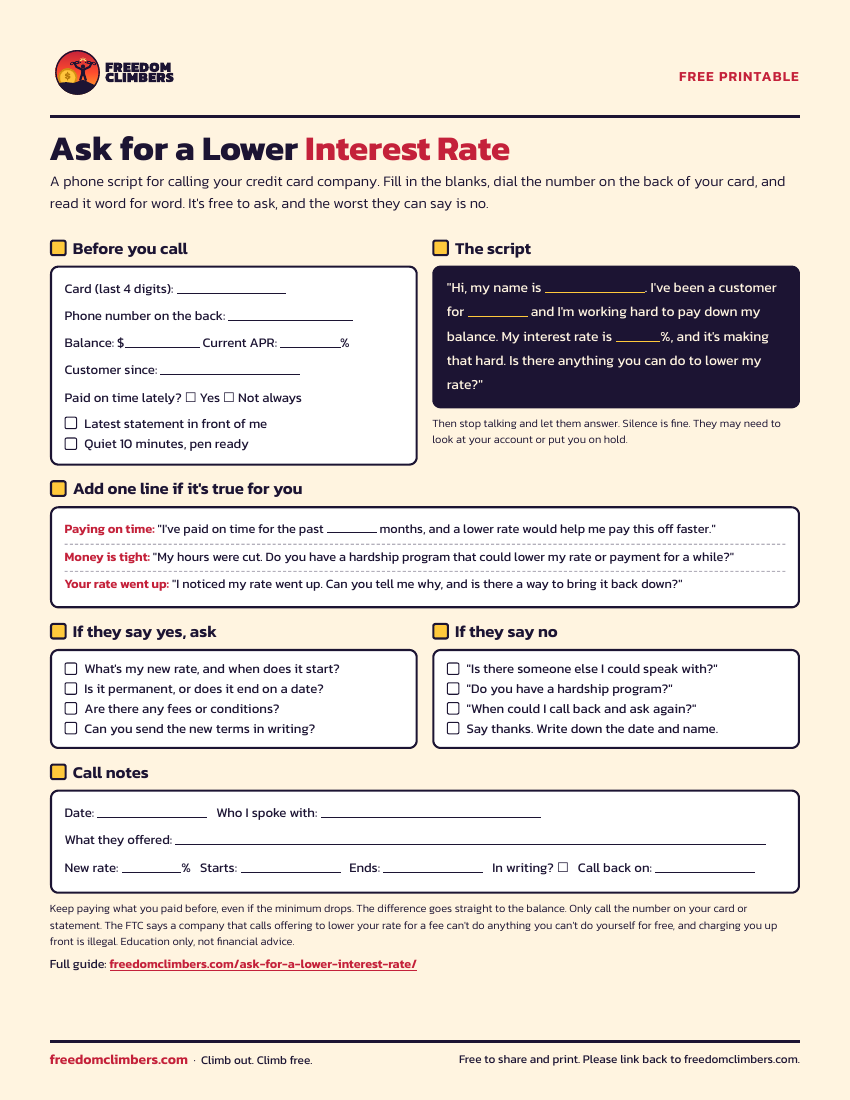
“Hi, I’ve been a customer for a while and I’m working hard to pay down my balance. My current interest rate is making that difficult. Is there anything you can do to lower my rate?”
Then stop talking and let them answer. Silence is fine. They may need to look at your account.
Add one line if it fits your situation:
Paying on time: “I’ve made my payments on time for the past year, and a lower rate would help me pay this down faster.”
Going through a hard time: “My hours were cut recently. Do you have any hardship programs that could lower my rate or payment for a while?”
Your rate went up: “I noticed my rate went up. Can you tell me why, and is there any way to bring it back down?”
Say what’s true for you. You don’t need a sad story. Simple and honest works.
What they say, and what you ask next
Reps usually come back with one of five answers. Here’s what to ask after each one. Nothing here is guaranteed; card companies decide case by case.
| If the rep says… | You ask next |
|---|---|
| “We can lower your rate to X%.” | “Is that permanent, or does it end on a date? Does it apply to my current balance or only new purchases? Can you send it in writing?” |
| “We can offer a lower promotional rate for 6 or 12 months.” | “What rate does it go back to, and on what date? Is there a fee? Does it cover the balance I have now?” Put the end date on your calendar. |
| “We have a hardship or payment program.” | “What happens to my card while I’m on it? Will it be closed or frozen? How long does it last, and what does it do to my payment?” See our hardship call script for the full set of questions. |
| “We can’t offer anything right now.” | “Is there a hardship program, or someone else I could speak with? When could I ask again?” Then write down the date and the rep’s name. |
| “You could apply for a balance transfer card or a new card.” | “Would that be a new application with a hard credit check? What’s the transfer fee, and when does the intro rate end?” This is a new product, not a lower rate on your card, so you don’t have to decide on the call. |
What a lower rate is actually worth
Here’s an example with made-up, round numbers, so you can see the math. Say you owe $3,000 on one card, you pay a fixed $150 every month, and you stop adding new charges. We figured interest each month as the APR divided by 12, then subtracted the payment.
| At 28% APR | At 20% APR | |
|---|---|---|
| First month’s interest | $70 | $50 |
| Months to pay it off | 28 | 25 |
| Total interest paid | $1,088 | $680 |
Same balance, same payment. The lower rate saves about $409 in interest and gets you done 3 months sooner. That’s why the key move after a yes is to keep paying what you paid before. If you drop to a lower minimum, most of the savings disappear.
Real cards are a little different. The CFPB explains that many card companies calculate interest daily, based on your average daily balance, so your exact numbers will vary by a few dollars. To run your own balance, use our debt payoff calculator, or add every card to the debt snowball spreadsheet to see how a new rate moves your debt-free date.
Before you say yes: five questions
- Which balance does it cover? Ask if the new rate applies to what you owe now, new purchases, or both. Most cards have more than one APR; the CFPB’s Know Before You Owe guide notes that different APRs can apply to different transactions and time periods. You’ll find yours on your statement.
- When does it end? A temporary rate can go back up when it expires. The CFPB says a temporary rate must last at least six months, and the federal help site for bank customers notes your card company doesn’t have to send advance notice when a promo rate ends if it already told you the terms. So write the end date down yourself.
- Is there a fee? A lower rate on your card shouldn’t cost a fee. A balance transfer usually does, so ask.
- Is there a credit check? A rate change on your existing card usually doesn’t need one. A new card or balance transfer card does. (More in the FAQ below.)
- Can I get it in writing? Ask for the new terms by mail or in your online account, then check your next statement.
A lower rate vs. a new card
If the rep steers you toward a balance transfer card, that’s a new product with its own application, fees and end date, not a change to the card you have. It can still help, but decide later, with the numbers in front of you. Our guide to whether a balance transfer is worth it walks through when it helps and when it hurts.
If your rate went up
Rate increases have rules. The CFPB says your card company generally must give you 45 days of notice before raising your rate on new purchases, and is generally restricted from raising the rate on your existing balance, with some exceptions. If your rate went up because you were more than 60 days late, it must bring back your old rate after six on-time minimum payments in a row. If that’s you, say so on the call: “I’ve made six on-time payments since my rate went up. Can you review it?”
Before you call
- Have your card and a recent statement in front of you.
- Note your current rate, your balance, and how long you’ve had the account.
- Be ready to say if you’ve been paying on time.
- Pick a quiet ten minutes, and grab a pen.
Always call the number on the back of your card yourself. Be wary of anyone who calls or texts you offering to lower your rate.
What the call usually looks like
- A phone menu. Say “representative” or choose “account questions.”
- Identity check. They’ll confirm it’s you. That’s normal when you call the number on your card.
- Your request. Read the script.
- A pause. They may look at your account or put you on hold. Stay on the line.
- The answer. Then ask your follow-up questions and write everything down.

Free printable: the lower interest rate phone script
Want it on paper? This one-page PDF has the script with blanks to fill in, the extra lines to add, what to ask if they say yes or no, and space for your call notes. Print it and keep it by the phone. No email signup. More one-page tools are on our free printables page.
Your call log
Copy this into a notebook:
- Date: ____
- Who I spoke with: ____
- What I asked for: ____
- What they offered: ____
- New rate, start and end dates: ____
- Written confirmation received? ____
- Follow-up date: ____
If the math doesn’t work
If you’re already behind, a lower rate may not be enough on its own. Call anyway and ask about a hardship plan; our hardship call script has the words. You can also talk with a nonprofit credit counselor. The CFPB says credit counselors can help you build a budget and may set up a debt management plan, and suggests getting any fees in writing first. If you’re still using the card for bills, start with how to stop using credit cards so the balance stops growing while you work on the rate.
Lower interest rate questions people ask
Does asking for a lower interest rate affect your credit score?
Usually not. The CFPB explains that your card company can check your credit report at any time to manage your account, a soft inquiry that doesn’t affect your score. A hard inquiry, which may, comes when you apply for a card or a line of credit. If the rep says they need to pull your credit, ask whether it’s a hard inquiry first.
Can you negotiate a lower interest rate on a credit card?
Yes, and asking costs nothing, though each company decides for itself. If you’re in a financial emergency, the CFPB says many card companies are willing to work with you to change your payment. Got a late fee too? Use our late fee script on the same call.
Should I pay a company that says it can lower my rate?
No. If someone calls or texts out of the blue offering to lower your credit card interest rate for a fee, hang up. You can make this same request yourself, for free, and it’s illegal for a debt relief company to charge you before it actually helps you. Don’t give your card, bank or Social Security number to anyone who called you.
The CFPB adds a few more warning signs to watch for: a company that guarantees it can make your debt go away, or tells you to stop talking to your card company or stop making your minimum payments. The real way to ask is free: call the number on the back of your card yourself and use the script above. Our debt relief scams guide covers the other red flags.
How often can I ask for a lower rate?
There’s no set rule. If you get a no, ask when it would make sense to call back, and try again after a few more months of on-time payments. Keep your call log so you can say what you were told last time.
What if I get nervous on the phone?
Totally normal. Write the script on a card and read it. It’s okay to say, “I’m a little nervous, so I’m reading from my notes.” The person on the other end talks to people all day. You’re not bothering them.
Your next step
The hardest part of this call is picking up the phone, so make it easy: find the customer service number on the back of your highest-interest card and put a 10-minute call on your calendar. Keep the table above open while you talk.
Next on the climb: Got a late fee on the same card? Ask about it on the same call with our late fee script.
Next climb: Nervous about looking at your numbers at all? Try a kinder way to look at them.
More words for tough calls: hard call scripts.