
You can often get a hospital bill lowered, and this free kit walks you through it in the order that saves the most: check the bill for errors, apply for the hospital’s financial assistance, then negotiate what’s left with a lump-sum offer or a 0% payment plan. It has the letters, checklists, four phone scripts, a deadline calculator and a call log. Print the PDF or fill it in on this page. No email or sign-up needed.
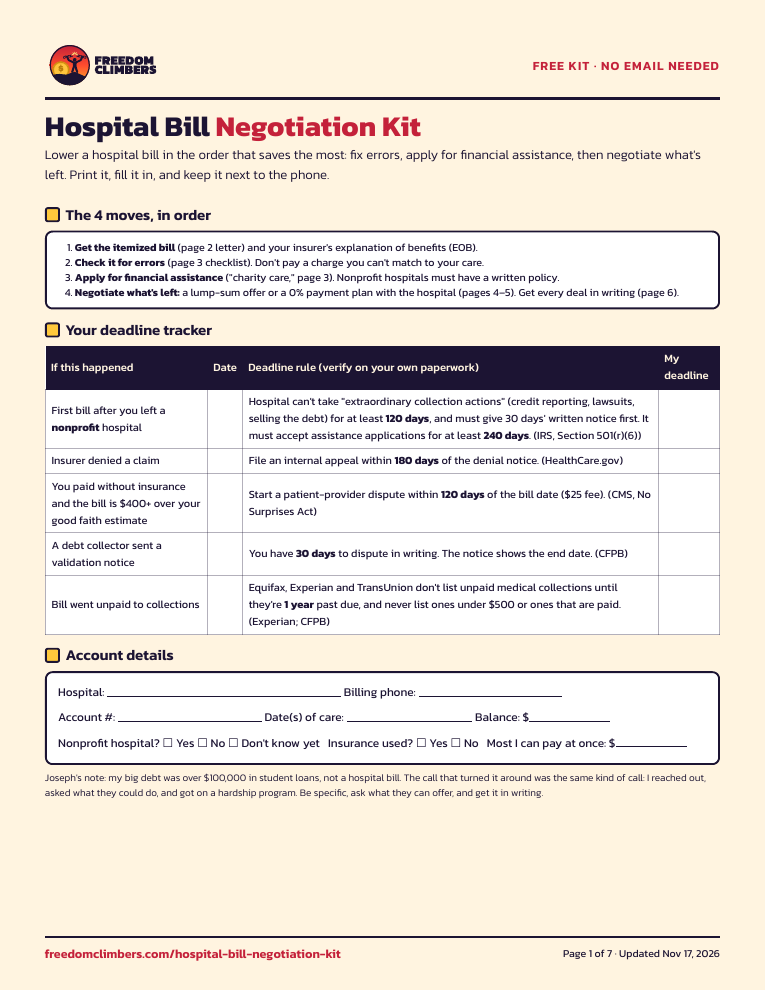
Joseph’s experience with this: My big debt wasn’t a hospital bill. It was more than $100,000 in student loans, and I fell so far behind that collectors were calling. The call that turned it around was the same kind of call this kit prepares you for. I reached out to my lenders, asked what they could do, and got on a hardship program that lowered my payments to interest only for a few years. Be specific, ask what they can offer, and get it in writing.
What’s in the kit
- Key deadlines + deadline calculator
- Step 1: Itemized bill request letter
- Step 2: Billing-error checklist
- Step 3: Financial assistance (charity care) checklist
- Step 4: Four phone scripts (errors and coding, financial assistance, lump-sum offer, payment plan)
- What percentage to offer, and why
- “Confirm our agreement” letter
- Medical debt and your credit report (2026 rules)
- Fill-in call log
- FAQ and sources
Key deadlines
Write these down first. Missing one can cost you a right you would otherwise have.
| If this happened | Deadline (federal minimum) | Source |
|---|---|---|
| You got your first bill after leaving a nonprofit hospital | The hospital can’t take “extraordinary collection actions” (like credit reporting, a lawsuit or selling the debt) for at least 120 days, and must give you 30 days’ written notice first. It must accept financial assistance applications for at least 240 days. | IRS, Section 501(r)(6) |
| Your insurer denied a claim | File an internal appeal within 180 days of the denial notice. | HealthCare.gov |
| You didn’t use insurance and the bill is $400 or more over your good faith estimate | Start a patient-provider dispute within 120 days of the bill date. There’s a $25 fee. | CMS |
| A debt collector sent you a validation notice | You have 30 days to dispute the debt in writing. The notice shows the end date. | CFPB |
| The bill went unpaid to collections | The three credit bureaus don’t add an unpaid medical collection until it’s 1 year past due. | Experian, CFPB |
Deadline calculator
Enter any date you have. Your deadlines appear below. Nothing you type leaves this browser.
These are federal minimums from the IRS, HealthCare.gov and CMS. Your hospital’s policy or your plan may allow more time, so check your own paperwork. A debt collector’s validation notice prints its own 30-day end date.
Step 1: Get the itemized bill (letter template)
The first bill is usually a summary. CMS suggests asking the billing department for a detailed bill that lists the cost of each item or service, plus your insurer’s explanation of benefits (EOB) and a copy of your medical records. Mail or email this letter to the hospital’s billing office (often called patient financial services) and keep a copy. Prefer to call first? Our itemized bill request guide has a 2-minute phone script.
[Date]
[Your name]
[Street address]
[City, state, ZIP]
[Phone or email][Hospital name]
Billing Department / Patient Financial Services
[Address]Re: Request for an itemized bill
Patient: [name] · Account #: [number] · Date(s) of service: [dates]To the billing department:
Please send me a complete itemized bill for the account above. For each charge, please list the date of service, a plain description, the billing code (CPT, HCPCS or revenue code), the quantity and the amount charged, plus every payment, insurance adjustment and discount applied to the account.
Please also send me a copy of your financial assistance policy, its plain-language summary and the application form.
I am not refusing to pay. I want to make sure the bill is correct before I do. While I review it, I ask that you hold this account and not refer it to a collection agency.
Please send the information to the address or email above. Thank you.
Sincerely,
[Signature]
[Printed name]
Asking to hold the account is a request, not a legal right, but it puts your review on the record. Note the date you sent it in the call log.
Step 2: Billing-error checklist
Go line by line with the itemized bill, your EOB and your records. These checks come from the CMS guide to checking a medical bill for errors and the CFPB’s medical bill rights page:
- Your details: name, address and insurance information are correct.
- You got it: you actually received every item and service listed.
- It’s in your records: CMS says you shouldn’t be billed for anything that isn’t documented in your medical records.
- No double billing: CMS notes it’s especially common when more than one provider treated you.
- Codes match your care: search each code with the words “medical billing code” and compare the description with what happened.
- Quantities and dates make sense: days in a room, doses, supplies and the dates of service.
- The balance matches your EOB: the “your share” amount on the EOB should be the same as the bill.
- Insurance was billed and payments were credited: ask for the claim date if you’re not sure it was sent.
- Surprise out-of-network bill? The No Surprises Act protects most insured people from unexpected out-of-network bills for emergency care, for non-emergency care related to a visit to an in-network hospital or surgery center, and for air ambulances.
- Paid without insurance? If the bill is at least $400 over your good faith estimate, you may be able to dispute it within 120 days. While the dispute is open, the provider can’t send the bill to collections.
Found something? Use Script 1. If you get stuck, CMS says your state’s Consumer Assistance Program may help with billing issues.
Step 3: Financial assistance (charity care) checklist
This is the step most people skip, and often the biggest one. Under IRS Section 501(r)(4), every nonprofit hospital must have a written financial assistance policy (FAP) that covers emergency and other medically necessary care, and it must be widely publicized. The policy has to spell out who qualifies, whether help means free or discounted care, how to apply, and which doctors working in the hospital are and aren’t covered. Not a nonprofit? Ask anyway. The CFPB says nonprofit hospitals, and some private hospitals, must provide free or reduced-fee care. Not sure if your income is low enough? Our free hospital financial assistance calculator shows your income as a percent of the 2026 federal poverty guidelines, the number most policies use. Then put your request in writing with our free financial assistance letter builder.
- Ask: “Are you a nonprofit hospital, and do you have a financial assistance policy?”
- Get three documents: the policy, the plain-language summary and the application.
- Read the eligibility rules (usually income and household size) and what each level of help covers.
- Check the list of covered providers. Doctors who bill separately may need their own application.
- Find the AGB percentage (“amounts generally billed”). The policy must state it or explain how to get it free. Under Section 501(r)(5), people who qualify can’t be charged more than AGB for emergency or medically necessary care, insured or not. You’ll also use it in Script 3.
- Gather what the application asks for. Hospitals may ask for things like recent pay stubs, a tax return, benefit letters and bank statements.
- Apply within 240 days of the first bill after discharge. That’s the minimum application period in Section 501(r)(6), and hospitals may accept applications later.
- Keep a copy of everything you send, and note the date.
- If your application is incomplete, the hospital must tell you how to complete it. Once it’s complete, the hospital must suspend collection actions, decide, and tell you its decision and the reasons in writing.
- Already paid some of it? If you qualify, the hospital must refund what you paid above your new amount, unless the difference is under $5.
- Might you qualify for Medicaid? The hospital may wait for that decision before deciding your application.
Step 4: Four phone scripts
Read them out loud, fill in the brackets, and write down the rep’s name and a reference number before you hang up. Each script has answers for the most common replies.
Script 1: Billing errors and coding
“Hi, my name is [name]. I’m calling about account [number] for care on [date]. I have my itemized bill and my insurer’s explanation of benefits, and I have questions about some charges before I pay. Line [number], code [code], is for [description], and [I don’t see it in my records / it’s billed twice / I didn’t receive it]. Can you check it against my medical record and send me a corrected bill? While you review it, can you put the account on hold so it isn’t sent to collections? Can I have a reference number for this call?”
If they say “That’s what was ordered”: “Can you show me where it’s documented in my record? I’d like a coding review of that line.”
If they say “Insurance already processed it”: “My EOB says my share is $[X], but your bill says $[Y]. Can you correct the bill or resubmit the claim?”
If they say “You’ll have to call the doctor’s office”: “Which provider billed that line, and what’s their billing phone number?”
Script 2: Financial assistance (charity care)
“Hi, I’m calling about account [number]. I’d like to apply for financial assistance. Can you send me your financial assistance policy, the plain-language summary and the application? Where do I send it, and what documents do you need? Will collection activity stay on hold while my application is reviewed? And does the policy cover the doctors who treated me, or do they bill separately?”
If they say “You probably make too much”: “I’d still like to apply and get a written decision. Can you tell me the income limits?”
If they say “It’s been months since your bill”: “Your policy has to accept applications for at least 240 days after the first bill after discharge. My first bill was dated [date].”
If they say “We’re not a nonprofit”: “Do you have any financial assistance, self-pay discount or hardship program anyway?”
If they offer a medical credit card: “No thanks. I’d like to apply for assistance first. If I still owe something after that, I’d like a payment plan with you directly.” The CFPB warns that once a hospital bill is on a regular or medical credit card, financial assistance may be harder to get, and deferred-interest promotions can charge interest on the full original amount if the balance isn’t paid off in time.
What percentage to offer, and why
No law sets a percentage, so be wary of anyone who promises a magic number. Start from the hospital’s own numbers and your real budget:
- The AGB percentage (nonprofit hospitals). Under the look-back method, it’s the share of gross charges that insurers such as Medicare allowed, on average, over a past year. For example, with round numbers: gross charges of $10,000 and an AGB of 40% means insurers paid about $4,000 for that care.
- The discounted cash price. Since 2021, CMS has required hospitals to publish their standard charges, including the discounted price a hospital is willing to accept from a patient paying cash. Search the hospital’s website for “price transparency” or “price estimator.” To compare hospitals’ published cash prices for the same procedure, try Patients Price.
- Your maximum. The most you can pay at once without missing rent, food, utilities or medicine. Decide it before you dial.
Open at the lowest of those anchors, or a little below it, and never agree above your maximum. No anchor? Ask them to name their self-pay or prompt-pay discount first, then counter below it. Why a lump sum can work: the hospital gets paid now, without months of billing and collection costs. The CFPB notes that providers value being paid quickly and avoiding the time and cost of billing and collecting.
Script 3: Lump-sum or prompt-pay offer
“After any assistance, my balance is $[X]. I can’t pay that, but I can pay $[offer] in one payment within [7] days if you accept it as payment in full. That’s based on [your AGB rate of __% / your posted cash price of $__]. Can you accept that?”
If they say no: “What’s the lowest amount you can accept as payment in full? Is there a supervisor or patient financial services manager who can approve more?” Then counter in small steps, never above your maximum.
If they say yes: “Thank you. Before I pay, please send it in writing: the amount, that it’s payment in full, that the balance will be $0, and that it won’t go to collections or be reported. How can I pay so I get a receipt?”
Script 4: Payment plan
“I want to pay this, but not all at once. I can pay $[amount] a month. Can you set up an interest-free payment plan directly with the hospital? Will the account stay out of collections as long as I pay on time? What happens if a payment is late? Please send me the terms in writing.”
If they say the monthly amount is too low: “My budget can’t do more than $[X] right now. Can we do $[X] for six months and then review it?”
If they say it’s only through a financing partner: “Is that a credit card or a loan? Is the interest deferred? I’d rather have a plan with you directly.”
Need help deciding what you can afford each month? Our hardship call script and debt list walk through it.
Get the deal in writing (“confirm our agreement” letter)
Don’t pay a settlement until the hospital confirms it in writing. If they won’t send a letter, send yours and keep proof it was delivered.
Date: [date] · Account #: [number] · Patient: [name]
To the billing department:
On [date], I spoke with [rep name] (reference # [number]). We agreed that:
[Choose one] A payment of $[amount] by [date] will be accepted as payment in full, leaving a balance of $0. / A payment plan of $[amount] a month for [number] months, starting [date], with no interest or fees.
Please confirm in writing that this agreement is correct, that the account will not be referred to collections or reported to a credit bureau while I keep to it, and, for a payment in full, that you will send a letter showing a $0 balance once it is paid.
Sincerely,
[Signature]
[Printed name]
Medical debt and your credit report: the rules in 2026
Here’s where things stand as of November 17, 2026, from the CFPB and the bureaus themselves:
- What the bureaus leave off. Equifax, Experian and TransUnion don’t include medical collections with an initial balance under $500, medical collections that have been paid, or unpaid medical collections less than one year past due. The CFPB recorded the bureaus’ 2022 announcement of these changes. They are the bureaus’ own policies, not a federal law.
- The 2025 CFPB rule is not in effect. In January 2025, the CFPB finalized a rule to keep medical debt off credit reports. On July 11, 2025, a federal court in the Eastern District of Texas vacated it, at the joint request of the CFPB and the plaintiffs. The CFPB’s rule page says its materials on that rule are for reference only.
- Medical credit cards are different. The CFPB says the reduced reporting of medical bills doesn’t apply to unpaid bills on a medical credit card or financing plan. Missed payments there can be reported like any other card.
- Nonprofit hospitals must wait. Reporting to a credit bureau is an “extraordinary collection action” under Section 501(r)(6), so the 120-day wait and 30-day notice apply first. If you’re later found eligible for assistance, the hospital must take reasonable steps to reverse those actions, including removing adverse information from your credit report.
- Something wrong on your report? You can dispute it with the bureau. Use our free credit report dispute letter. If a collector contacts you, you can ask them to verify the debt, and you have 30 days after their validation notice to dispute it in writing. See what to say to debt collectors.
Your state may have extra medical-debt protections. Your state attorney general’s consumer office can tell you what applies where you live.
Fill-in call log
Names, dates and reference numbers are your proof if something goes wrong later. Fill it in here, or use page 7 of the printable PDF.
Fill-in call log
One row per call or letter. Entries are saved only in this browser on this device; nothing is sent to us.
| Date | Who (dept, phone) | Rep name / ID | What I asked | What they said or agreed | Ref # | Next step / by |
|---|
FAQ
Can you really negotiate a hospital bill?
Yes. You can ask for a corrected bill, apply for financial assistance, offer a lump sum, or ask for a payment plan. None of these is guaranteed, which is why the kit starts with the steps backed by rules (errors, financial assistance and deadlines) before the steps that depend on the hospital saying yes.
Does this work if I have insurance?
Yes. Check the bill against your EOB, appeal a denied claim within 180 days, and still apply for financial assistance for what you owe after insurance. The IRS says the AGB limit applies to everyone who qualifies under the policy, without regard to insurance status.
My hospital bill is already in collections. Is it too late?
Not necessarily. Ask the collector to verify the debt within the 30-day window on its notice, and ask the hospital whether you can still apply for financial assistance. The IRS says nonprofit hospitals may continue to accept and process applications at any time, and the 240-day period is a minimum.
Should I put the bill on a credit card?
Be careful. The CFPB says doing so may make financial assistance harder to get, and medical credit cards often use deferred interest. Ask about financial assistance and a direct payment plan first.
Is the kit really free?
Yes. No email, no sign-up and no ads in the PDF. You're welcome to print it, share it, and link to it.
For librarians, social workers, patient advocates and teachers
You're welcome to link to this kit from a resource guide, class page or handout. No permission needed. Copy-paste link code:
<a href="https://freedomclimbers.com/hospital-bill-negotiation-kit/">Hospital Bill Negotiation Kit (free, no sign-up) from Freedom Climbers</a>Short description you can reuse: "A free, printable kit for lowering a hospital bill: itemized-bill request letter, billing-error and financial-assistance checklists, four phone scripts, deadline calculator and call log, with IRS, CMS and CFPB sources."
More free tools: all our free debt and budget tools · how to negotiate a hospital bill down · more hard-call scripts · who to call when you can't pay a bill.
Sources
Every rule on this page was checked against these sources on November 17, 2026. Rules can change, so check the current version before you rely on a deadline.
- IRS: Financial assistance policy and emergency medical care policy, Section 501(r)(4); Limitation on charges, Section 501(r)(5); Billing and collections, Section 501(r)(6)
- CMS: Medical bill rights (No Surprises Act); Dispute a medical bill; Check your medical bill for errors; Hospital price transparency for consumers
- HealthCare.gov: Internal appeals
- CFPB: Medical credit cards and payment plans; Know your rights and protections when it comes to medical bills and collections; What information a debt collector has to give you; Medical information rule (Regulation V), vacated July 11, 2025
- Experian: How does medical debt affect your credit score?
This kit is general education, not legal, tax or financial advice. For help with your situation, a legal aid office or your state's Consumer Assistance Program may be able to help.