

You found it: a late payment you never made, an address you never lived at, or a card you never opened. Fixing it is mostly paperwork, and today we hand you the paper: a credit report dispute letter template you can fill in tonight, as a free printable PDF or a Word file you can type into.
Welcome to Word-for-Word Wednesday, where we give you the exact words to use. Yesterday you learned how to check your credit report for free. Today: the letter, what to attach, where to send it, and what happens after it lands.
Free printable credit dispute letter template (PDF and Word)
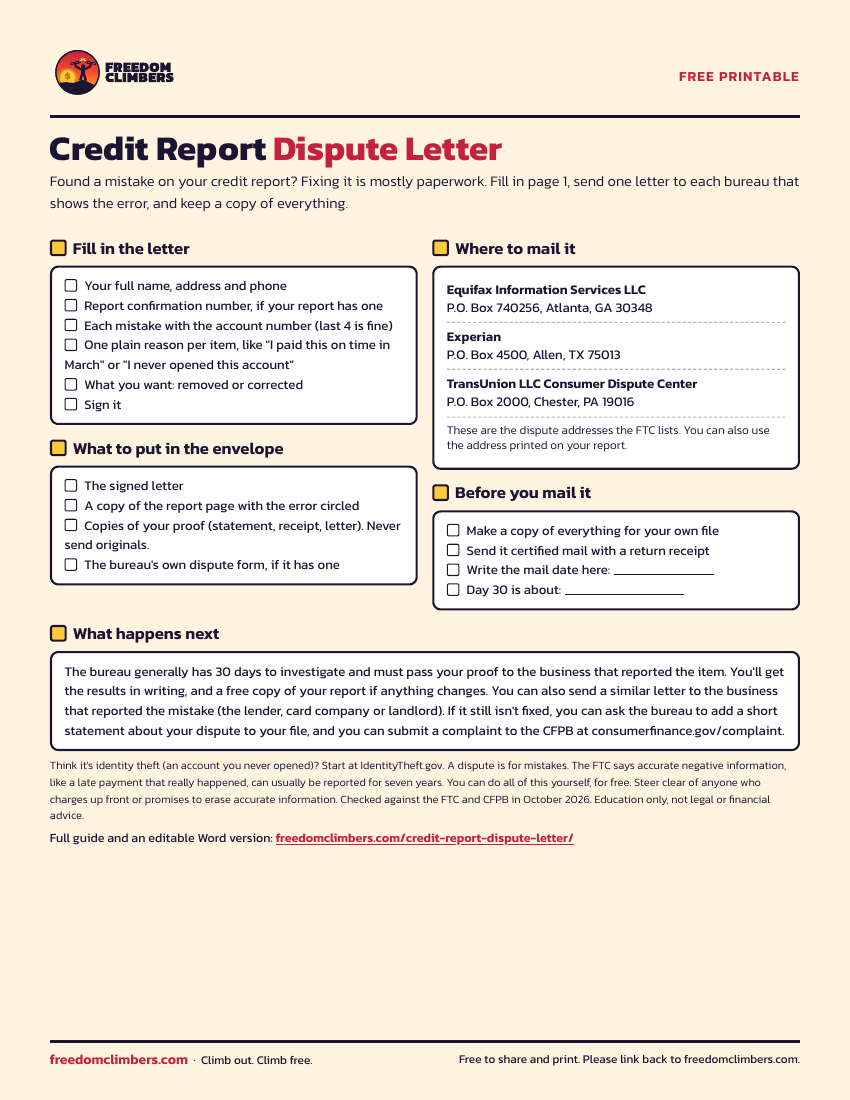
Two free versions of the same letter. Print the PDF and fill it in by hand, or open the Word file and type it. Page 2 of the PDF is a checklist: what to put in the envelope, where to mail it and what happens next. No email signup.
Why a letter works
The Federal Trade Commission explains that your report can affect whether you can borrow money and how much it costs, and even getting a job, insurance or a place to rent. The FTC also says both the credit bureau and the business that supplied the information have to correct information that’s wrong or incomplete, and they have to do it for free.
You can dispute online or by phone too, but a letter gives you something solid: a clear record of what you asked for and when.
What goes in a credit report dispute letter template?
The Consumer Financial Protection Bureau lists what a mailed dispute letter should include: your contact information, the credit report confirmation number if you have one, each error with its account number, a clear reason it’s wrong, a request to remove or correct it, a copy of the report page with the error circled or highlighted, and copies (not originals) of supporting documents.
The dispute letter, word for word
Here’s the same letter as text. Copy it, fill in the brackets, and send one to each bureau showing the mistake. Rather type it? The Word template has the same wording.
[Today’s date]
[Your full name]
[Your street address, city, state, ZIP]
[Your phone number]
[Credit bureau name]
[Dispute address from your report or the bureau’s website]
Re: Dispute of inaccurate information. Report confirmation number: [number, if any]
To whom it may concern:
I am writing to dispute the following information in my credit file. The items I dispute are circled on the attached copy of my report.
Item 1: [Company name], account ending in [last four digits]. This item is [inaccurate or incomplete] because [plain reason, for example: “I paid this bill on time in March” or “I never opened this account”].
I am requesting that this item be [removed or corrected to show ___].
Enclosed are copies of [list each document, such as a bank statement or payment receipt] supporting my position. Please investigate this matter and send me the results in writing.
Sincerely,
[Your signature]
[Your printed name]
Keep it short and factual: one item per paragraph, no long story.

What to attach (and what to keep)
- A copy of the report page with the error circled.
- Copies of your proof: a statement, receipt or letter that shows the truth. Never send originals.
- The bureau’s dispute form, if it has one. The FTC says to include it.
- Your own file: a copy of the letter and everything you mailed.
The FTC suggests certified mail with a “return receipt,” so you have proof the bureau got it.
Where to send it
The FTC lists these mailing addresses for disputes. You can also use the address printed on your report.
- Equifax Information Services LLC, P.O. Box 740256, Atlanta, GA 30348
- Experian, P.O. Box 4500, Allen, TX 75013
- TransUnion LLC Consumer Dispute Center, P.O. Box 2000, Chester, PA 19016
Consider sending a similar letter to the business that reported the mistake, like the lender. The CFPB says those businesses, called furnishers, generally must investigate and respond within 30 days.
What happens next
According to the FTC, the bureau has 30 days to investigate and must forward your evidence to the business that reported the item. You’ll get the results in writing, and if something changes, a free copy of your report. If the bureau decides your dispute is “frivolous,” it has to tell you why; often that means you need to add more detail or proof.
If the investigation doesn’t settle it, you can ask the bureau to add a statement of the dispute to your file.
Here’s an example with made-up, round numbers
Remember Sam from yesterday? Sam’s Experian report shows an old phone bill marked 30 days late, even though Sam paid it. Sam fills in the template with the phone company’s name, the last four digits of the account and one sentence: “I paid this bill on time; my bank statement shows the payment.” Sam circles the line on the report, makes copies of the bank statement, keeps a full set and mails the letter certified.
The store card Sam never opened is different. That one may be identity theft, so Sam starts at IdentityTheft.gov, which the FTC recommends for reporting it and getting a recovery plan.
If the math doesn’t work
Sometimes the late payment is real because money truly ran out. A dispute is for errors, not for accurate history, and the FTC says correct negative information can be reported for most of seven years. That doesn’t make you stuck. If a bill is about to go late again, call before it does with our hardship call script, and keep essentials first: housing, utilities, food and getting to work.
Your climb today
One error, one letter, one stamp. You don’t have to fix your whole file tonight. Write down the date you mailed it on your debt list so you know when 30 days are up.
Next climb: If you haven’t pulled all three reports yet, start there so you know what to dispute. How to Check Your Credit Report for Free (and Spot Errors)
Tomorrow on the climb: Safety-Net Thursday. Car registration, birthdays, school fees: “surprise” bills that aren’t surprises. We’ll show you sinking funds for beginners, a simple list that turns big yearly costs into paycheck-sized pieces.
Featured photo: Jesse R on Pexels (New York, New York, United States).



Leave a Reply